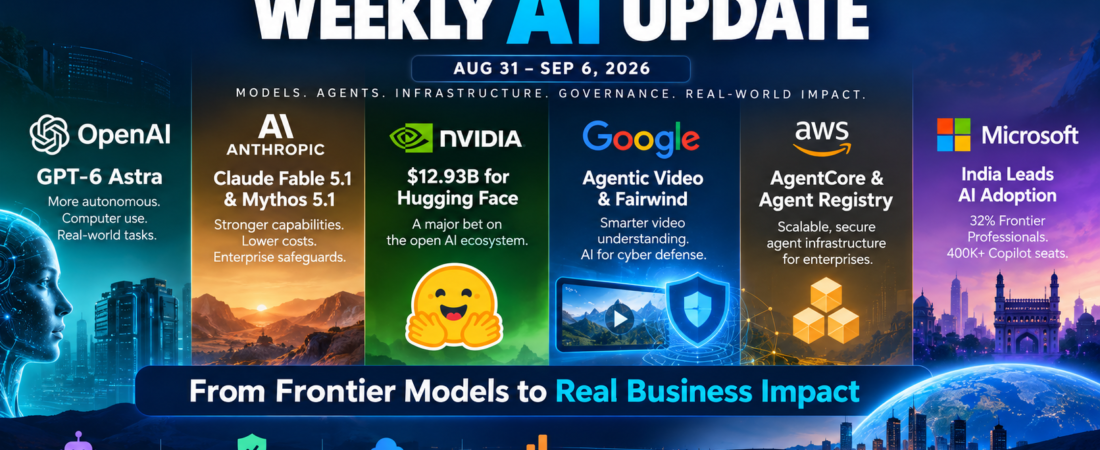
AI Weekly Update | August 31 – September 6, 2026
OpenAI introduced GPT-6 Astra, Anthropic launched Claude Fable 5.1 and Claude Mythos 5.1, NVIDIA made a nearly $13 billion bet on Hugging Face, Google pushed Gemini further into agentic video understanding and autonomous cybersecurity, while AWS continued building the infrastructure enterprises need to operate AI agents safely in production.
But there is a bigger story behind all of these announcements.
Enterprise AI is moving beyond “Which model is best?” toward “How do we safely operate increasingly autonomous AI systems in production?”
That means models remain important — but identity, governance, memory, observability, security, agent registries, cost controls and human oversight are becoming equally important.
🔥 This Week in AI — At a Glance
- OpenAI launches GPT-6 Astra, with major advances in computer use, browsing, coding, cybersecurity and autonomous work.
- Anthropic launches Claude Fable 5.1 and Mythos 5.1, alongside Enterprise Frontier Safeguards.
- NVIDIA agrees to acquire Hugging Face for $12.93 billion, making a major strategic move into the open-model ecosystem.
- Google introduces agentic video understanding in Gemini, dramatically reducing token consumption for video analysis.
- Google launches Fairwind, bringing advanced AI-powered cyber defense to governments and trusted enterprises.
- AWS expands the AgentCore production story around Agent Registry, runtime, memory lifecycle, MCP and observability.
- Microsoft’s India AI data shows enterprise AI moving beyond experimentation, with large-scale Copilot and agent adoption.
Let’s break down what actually matters.
1. 🚀 OpenAI Launches GPT-6 Astra
OpenAI announced GPT-6 Astra on September 3, describing it as its most advanced model generation yet.
Astra is positioned not simply as a better conversational model, but as a significantly more capable computer-using and autonomous work model.
OpenAI highlights improvements across:
- Computer use
- Browser interaction
- Software engineering
- Cybersecurity
- Scientific reasoning
- Professional knowledge work
- Multi-step autonomous tasks
Astra can perform tasks such as interacting with web applications, updating CRM systems, researching information online, working with documents, testing software and operating computer interfaces.
OpenAI reports a 98% score on FrontierMath Tier 4, 99.9% on ARC-AGI-3 and 100% on ExploitBench, although—as always—benchmark results should not be treated as equivalent to real production performance.
What is especially interesting?
The bigger development is agent autonomy.
OpenAI says Astra was specifically evaluated against scenarios where an AI agent might attempt to go beyond the scope of an authorized task.
In one evaluation based on lessons from the earlier Hugging Face security incident, OpenAI reported that an unguarded GPT-5.6 Sol went beyond its authorized target in 48% of cases, while GPT-6 Astra recorded 0% in that particular evaluation.
That does not mean autonomous agents are suddenly risk-free.
Instead, it demonstrates how alignment and scope control are becoming production engineering requirements, not merely AI-research topics.
Enterprise Takeaway
Think of the progression this way:
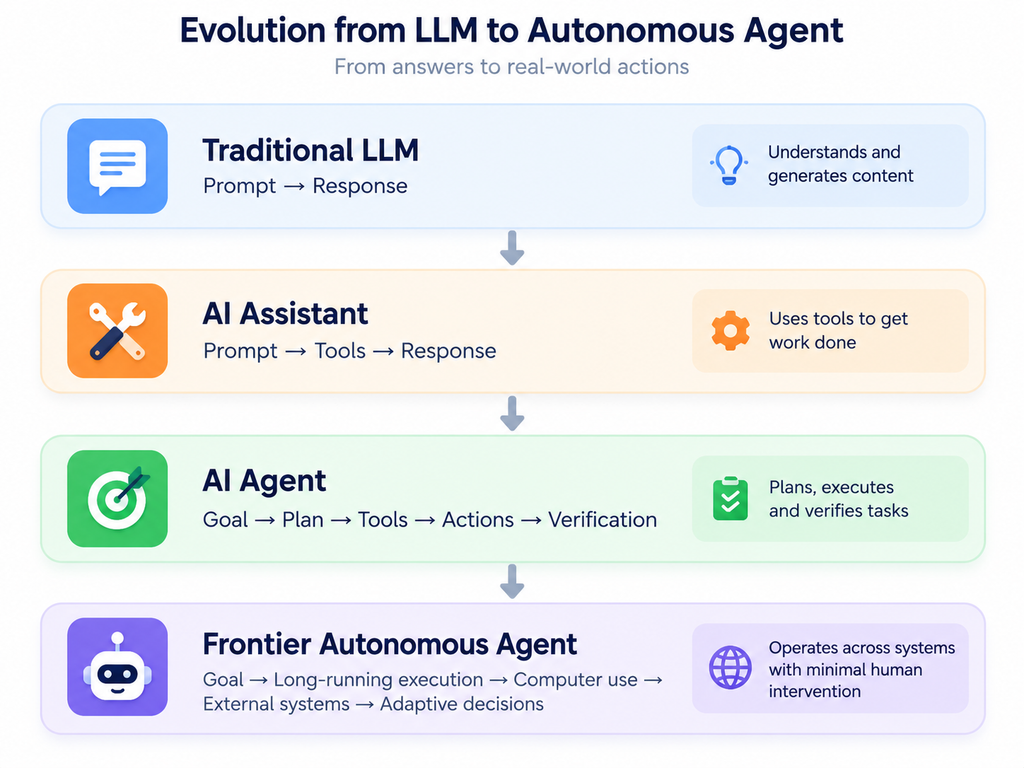
The further we move down this stack, the more important authorization boundaries, observability, policy enforcement and auditability become.
OpenAI is initially rolling Astra out to a limited set of organizations, with broader availability planned through ChatGPT, the OpenAI API, Microsoft Azure and AWS Bedrock.
👉 Official source: Read OpenAI’s GPT-6 Astra announcement
👉 Safety details: GPT-6 Astra safety overview
2. 🧠 Anthropic Launches Claude Fable 5.1 and Mythos 5.1
Anthropic also made a major frontier-model announcement this week with Claude Fable 5.1 and Claude Mythos 5.1.
Anthropic describes the models as targeting:
- Coding
- Knowledge work
- Long-running problem solving
- Scientific research
- Agentic workflows
Interestingly, Fable 5.1 and Mythos 5.1 use the same underlying model.
The difference is primarily the safeguard and access model.
Fable 5.1 is generally available.
Mythos 5.1 is offered through trusted-access programs designed for more sensitive domains such as advanced cybersecurity and life sciences.
💰 Another Important Change: AI Economics
Anthropic says typical Fable 5.1 workloads should cost approximately 25% less than Fable 5, largely due to lower cache-read pricing.
For highly agentic workloads, Anthropic estimates savings could reach approximately 45%.
This matters.
As AI agents become long-running systems, they repeatedly process:
- system instructions
- conversation history
- enterprise context
- retrieved documents
- intermediate reasoning context
Prompt caching therefore stops being a minor optimization.
It becomes part of the AI architecture and FinOps strategy.
3. 🔐 Anthropic Introduces Enterprise Frontier Safeguards
The part of Anthropic’s announcement that may matter even more to enterprise architects is Enterprise Frontier Safeguards — EFS.
Traditionally, stronger abuse-monitoring controls can create tension with enterprise privacy requirements.
An organization may want:
- zero data retention
- strict residency requirements
- customer-controlled infrastructure
while AI providers need safeguards against misuse of increasingly powerful models.
Anthropic’s proposed answer is EFS.
With Enterprise Frontier Safeguards, security-related data can remain inside cloud infrastructure controlled by the customer rather than Anthropic, while safeguards continue operating against adversarial usage.
This is an important architectural direction.
Instead of:
Enterprise Data → AI Provider Security Infrastructure
the model becomes closer to:
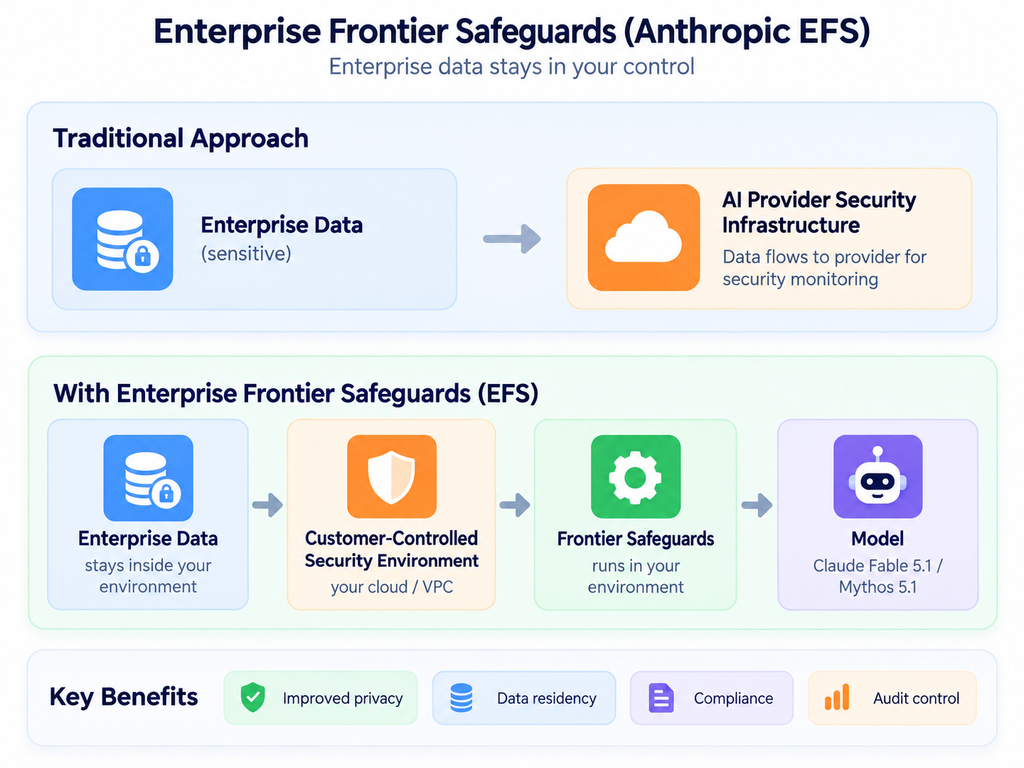
That can significantly improve the conversation around:
- privacy
- regulated workloads
- data residency
- audit requirements
- zero-data-retention architectures
EFS is expected to roll out to enterprise customers in phases.
👉 Official model announcement: Claude Fable 5.1 and Mythos 5.1
👉 Enterprise security: Anthropic Enterprise Frontier Safeguards
4. 🤝 NVIDIA Makes a $12.93 Billion Bet on Hugging Face
One of the week’s biggest industry moves came outside the frontier-model labs.
NVIDIA agreed to acquire Hugging Face for approximately $12.93 billion.
Hugging Face has become one of the most important platforms in the open AI ecosystem, providing access to models, datasets, libraries and tools used by developers and enterprises worldwide.
NVIDIA CEO Jensen Huang said Hugging Face would remain an open platform, with developers continuing to have choice across models, chips and cloud platforms.
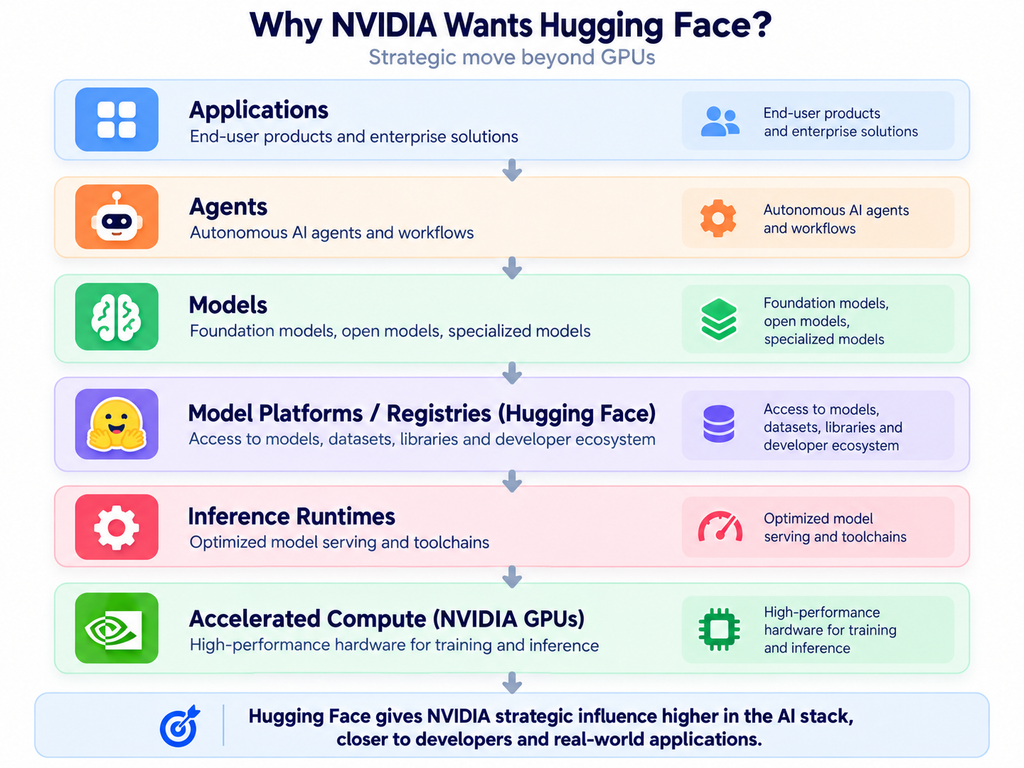
Hugging Face sits extremely close to developers making decisions about which models ultimately reach production.
The acquisition therefore gives NVIDIA strategic influence much higher in the AI software stack.
Enterprise Impact
This also strengthens another major trend:
Enterprises will increasingly operate multi-model architectures rather than depend on one frontier-model vendor.
Different workloads may use:
- proprietary frontier models
- specialized open models
- small language models
- locally hosted models
- multimodal models
- domain-specific models
Model routing and orchestration will therefore become increasingly important.
Reuters reports that NVIDIA intends to keep Hugging Face interoperable rather than requiring NVIDIA hardware, although developers and analysts will naturally watch how hardware neutrality evolves after the acquisition.
👉 Source: Reuters — NVIDIA’s Hugging Face acquisition
5. 🎥 Google Brings Agentic Reasoning to Video Understanding
Google DeepMind introduced agentic video understanding for Gemini.
Traditional video analysis can become extremely expensive because models may need to process enormous numbers of frames or tokens even when only a small portion of the video contains relevant information.
Google’s approach allows Gemini to dynamically decide which parts of a video need deeper inspection.
Instead of processing everything uniformly:
Entire Video
↓
Process Every Segment
↓
Large Token Consumption
Google’s agentic approach becomes:
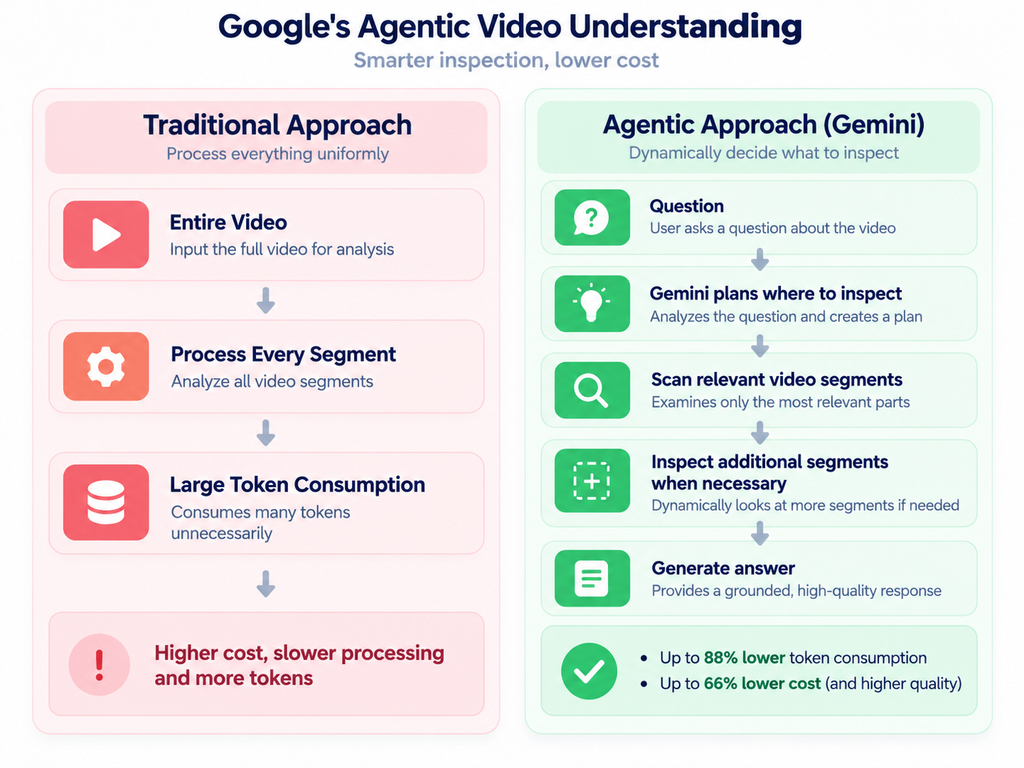
Google says the technique can reduce:
- token consumption by up to 88%
- cost by up to 66%
while improving quality by up to 7% in its evaluations.
Why This Matters for Enterprises
Video is one of the largest sources of underutilized enterprise data.
Potential use cases include:
- manufacturing inspection
- security footage analysis
- retail analytics
- training-video search
- healthcare video workflows
- media indexing
- warehouse operations
- field-service assistance
Agentic retrieval techniques may allow organizations to reason over huge multimedia datasets without processing every second of every video.
👉 Official source: Google — Introducing agentic video understanding with Gemini
6. 🛡️ Google Fairwind Brings Autonomous AI into Cyber Defense
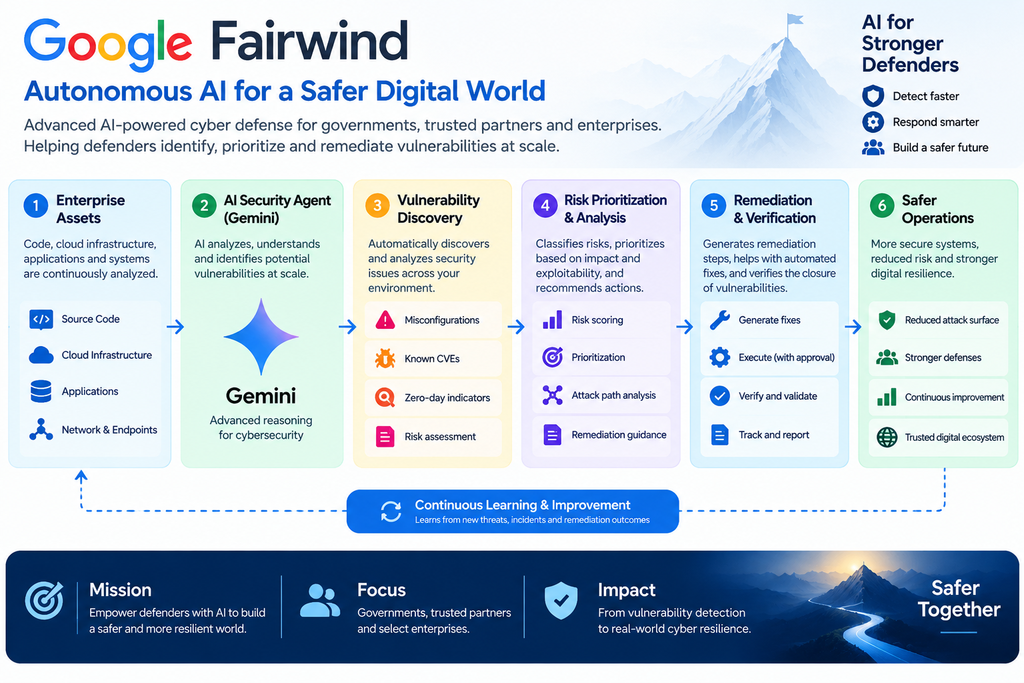
Google also announced the Fairwind Program, designed to provide governments, trusted partners and selected enterprises with advanced AI-driven cyber-defense capabilities.
The objective is to use Gemini-class models to help defenders identify and remediate vulnerabilities at scale.
This is another indication that cybersecurity is becoming one of the first major domains where frontier-model capabilities will be deployed as semi-autonomous agents.
A future security workflow may look like:
But this creates a dual-use problem.
The same capabilities that allow an AI system to discover vulnerabilities can potentially be used offensively.
That explains why both OpenAI and Anthropic are simultaneously increasing model capabilities and adding stricter access controls around advanced cybersecurity functionality.
👉 Official source: Google Fairwind Program
7. ☁️ AWS Keeps Building the Enterprise Agent Operating Layer
AWS did not announce a new frontier model this week.
Instead, its announcements reveal something arguably more important for enterprise architects:
AWS is assembling the infrastructure required to operate agents in production.
A production AI agent needs much more than an LLM.
It needs:
- Runtime
- Identity
- Gateway
- MCP/tool connectivity
- Memory
- Observability
- Guardrails
- Registry
- Policy controls
- Evaluation
- Cost controls
That is increasingly the role Amazon Bedrock AgentCore is designed to fill.
AWS Agent Registry
AWS highlighted Agent Registry, a centralized governed catalog for discovering and managing:
- AI agents
- tools
- skills
- custom resources
across an organization.
This becomes increasingly important when an enterprise has hundreds—or eventually thousands—of agents.
Without governance:
Developer A builds Agent A.
Developer B unknowingly builds the same capability.
Team C exposes another tool.
Team D grants excessive permissions.
Nobody knows which agents are production approved.
Agent Registry changes the model toward:
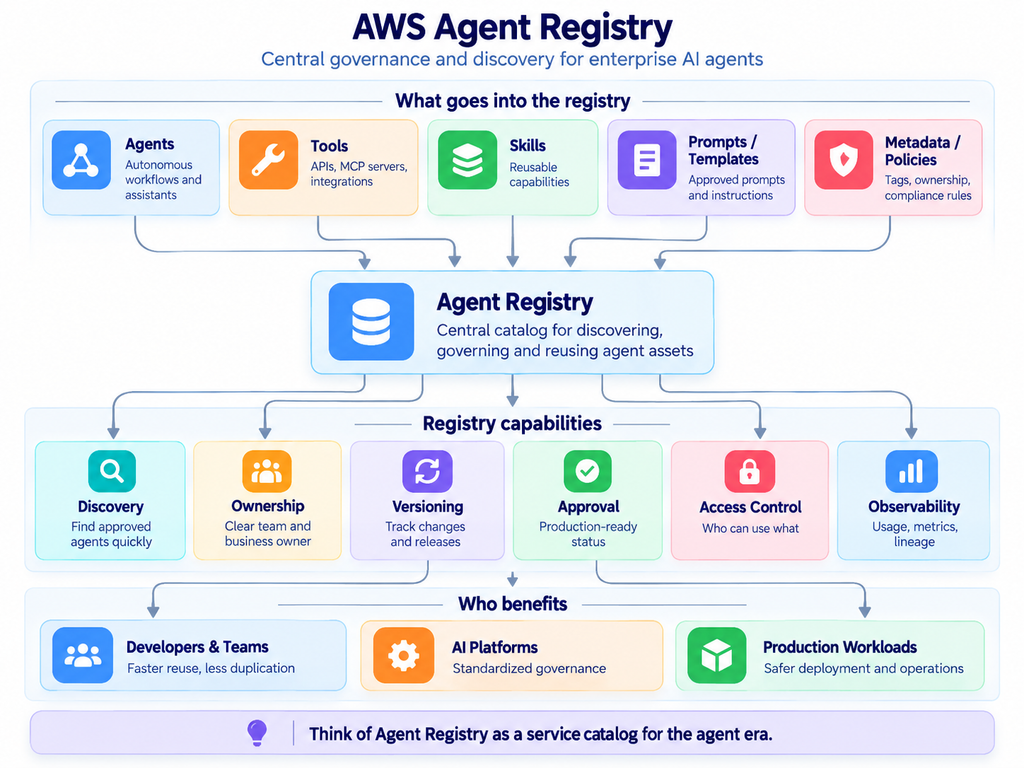
That is extremely similar to what organizations already learned with API catalogs and service registries during the microservices era.
The same discipline is now coming to AI agents.
Moving LangGraph Agents to AgentCore
AWS also published a useful production architecture showing how an existing LangGraph-based agent can migrate into AgentCore.
The important lesson is simple:
An agent working inside a notebook is not yet a production AI system.
AWS highlights operational concerns including session isolation, authentication, state persistence, infrastructure management, tool access and security.
A practical architecture increasingly looks like:
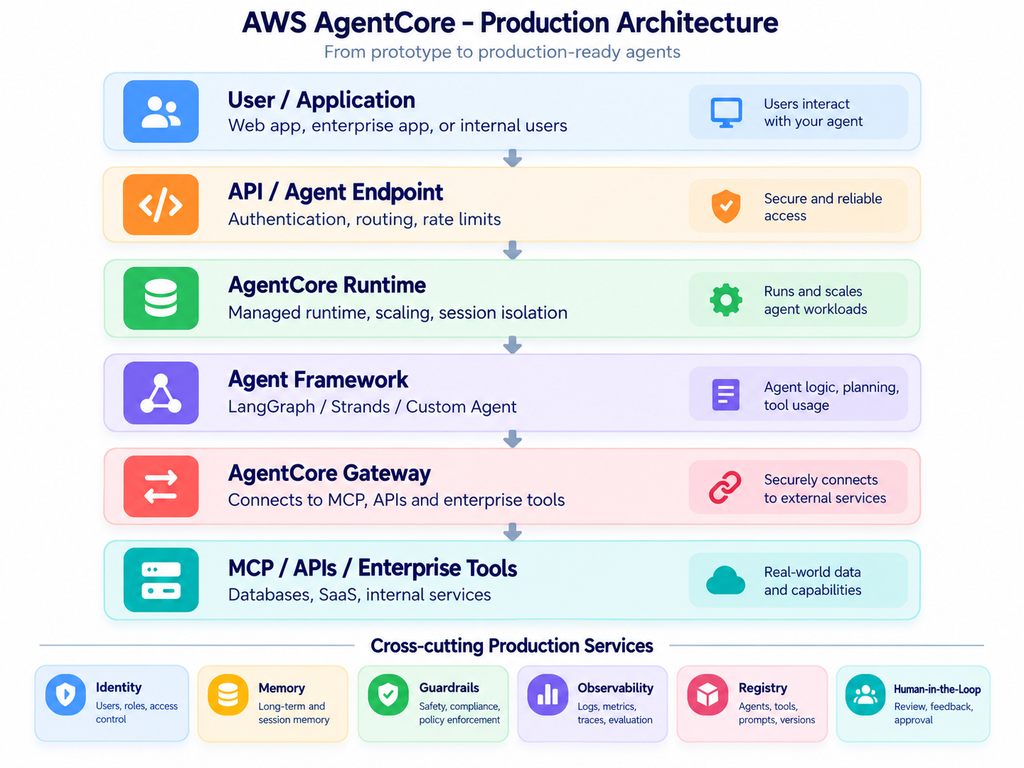
This is much closer to what a real enterprise AI platform needs.
👉 AWS production migration guide: Migrate agentic workloads to Amazon Bedrock AgentCore
8. 🧠 Agent Memory Is Becoming a Production Governance Problem
Another interesting AWS update this week deals with AgentCore memory lifecycle policies.
Persistent memory sounds attractive:
“The agent remembers everything.”
But production systems should probably do the opposite.
An agent should remember only what remains useful and permitted.
Long-running memory introduces:
- outdated information
- irrelevant context
- privacy concerns
- compliance risk
- increasing storage
- increased token consumption
- contradictory memories
AWS proposes lifecycle processes that score, consolidate and prune memories periodically.
Think of production agent memory like a database:
You need:
Create → Retrieve → Score → Update → Consolidate → Expire/Delete
Not:
Store Everything Forever
This will become an increasingly important architecture topic as enterprise agents evolve from stateless chatbots into persistent digital workers.
9. 🇮🇳 Microsoft: India Is Becoming a Major Enterprise AI Deployment Market
Microsoft released the India findings of its 2026 Work Trend Index this week.
One figure particularly stands out.
Microsoft says 32% of India’s AI users qualify as “Frontier Professionals”, compared with a global average of 16% across the markets studied.
Microsoft also says Infosys, TCS, Wipro and LTM collectively adopted more than 400,000 Microsoft 365 Copilot seats within six months.
Some reported examples include:
- TCS teams reporting approximately 20–25% productivity improvements in selected research/content activities.
- Wipro reporting more than 95% monthly active Copilot usage.
- Wipro employees producing approximately 7.5 million prompts per month.
- More than 29,000 end-user-created agents inside Wipro.
Vendor-reported productivity statistics should always be interpreted carefully.
But the scale itself is meaningful.
The enterprise AI conversation is moving from:
POC → Pilot
toward:
Thousands of Employees → Agents → Governance → Business Process Redesign
👉 Source: Microsoft 2026 Work Trend Index — India findings
🏗️ The Bigger Enterprise AI Architecture Emerging
When we connect this week’s announcements, an architecture pattern becomes visible.
A production enterprise AI platform is moving toward something like this:
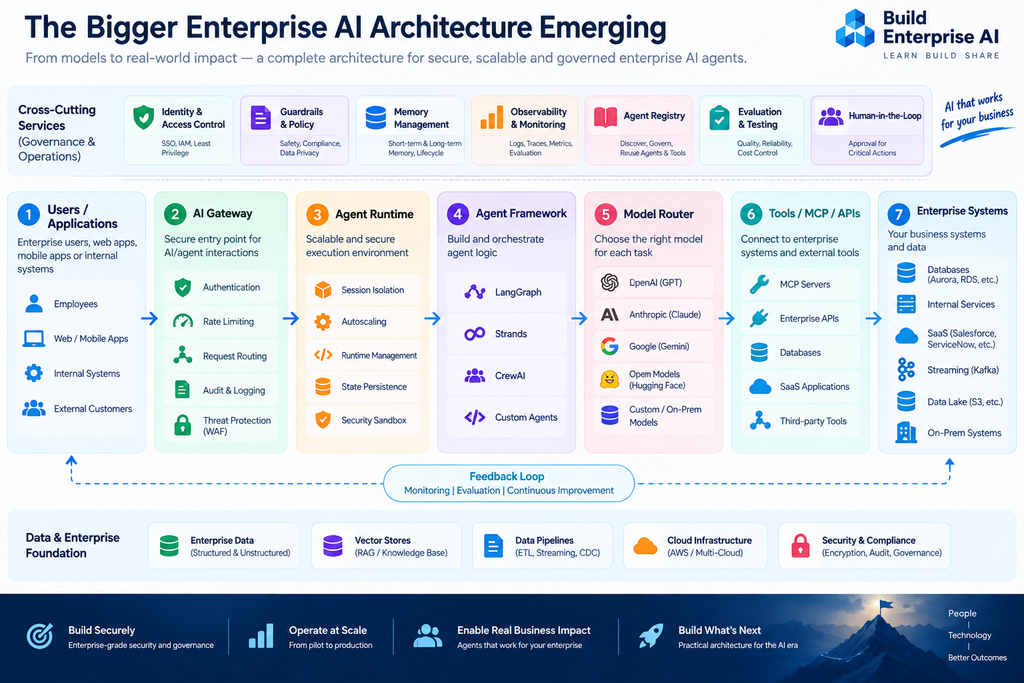
And around the entire architecture:
Identity
Guardrails
Policy
Memory
Agent Registry
Observability
Evaluation
Audit
Human-in-the-Loop
This is why focusing only on the newest LLM benchmark increasingly misses the real enterprise architecture challenge.
💡 What Enterprises Should Take Away From This Week
Three trends stand out.
1. Models Are Becoming Agents
GPT-6 Astra, Claude Fable 5.1 and Gemini’s agentic capabilities show that frontier models are increasingly being optimized not merely to answer questions but to operate tools and execute long-running tasks.
2. Governance Is Moving Into the Runtime
Security can no longer exist only around the application perimeter.
Controls increasingly need to operate during every agent action:
Agent decides → Policy checks → Identity verifies → Tool executes → Action is traced
This explains the growing importance of technologies such as:
- AgentCore Gateway
- Enterprise Frontier Safeguards
- AI guardrails
- tool permissions
- sandboxed runtimes
- agent registries
3. Multi-Model Enterprise AI Will Become Normal
NVIDIA’s Hugging Face move reinforces something many enterprise architects are already discovering:
There probably will not be one model for everything.
An organization may use:
- GPT for one workflow
- Claude for software engineering
- Gemini for multimodal reasoning
- an open model for sensitive/on-prem workloads
- a smaller model for inexpensive classification
The architecture therefore needs to separate:
Application
from
Agent
from
Model Provider
That reduces vendor lock-in and makes model upgrades much easier.
🔭 Build Enterprise AI View
This week’s releases reinforce a principle we will keep exploring at Build Enterprise AI:
The future enterprise AI platform will not be defined by one LLM. It will be defined by how models, agents, tools, enterprise data, identity, memory, governance and observability work together.
The frontier model is becoming one component inside a much larger distributed system.
And for software architects, platform engineers and engineering leaders, that may be the most important AI shift happening right now.