For the last few years, enterprise AI conversations have focused on one question:
How capable is the model?
Can it write code? Can it reason over large documents? Can it use tools, operate a browser, or solve complex cybersecurity problems?
Increasingly, the answer is yes.
But this week’s developments point toward a more important enterprise question:
How much authority should we safely delegate to AI?
On August 18, OpenAI said preliminary evidence suggests its upcoming Astra model may meet the “Critical” cybersecurity capability threshold under its Preparedness Framework. OpenAI has slowed or paused some higher-risk frontier-model activities while strengthening monitoring, alignment, workload isolation and network security.
On the same day, AWS made Amazon Bedrock AgentCore Payments generally available, allowing AI agents to autonomously pay for paid APIs, MCP services and digital content while enforcing spending limits and observability at the infrastructure layer.
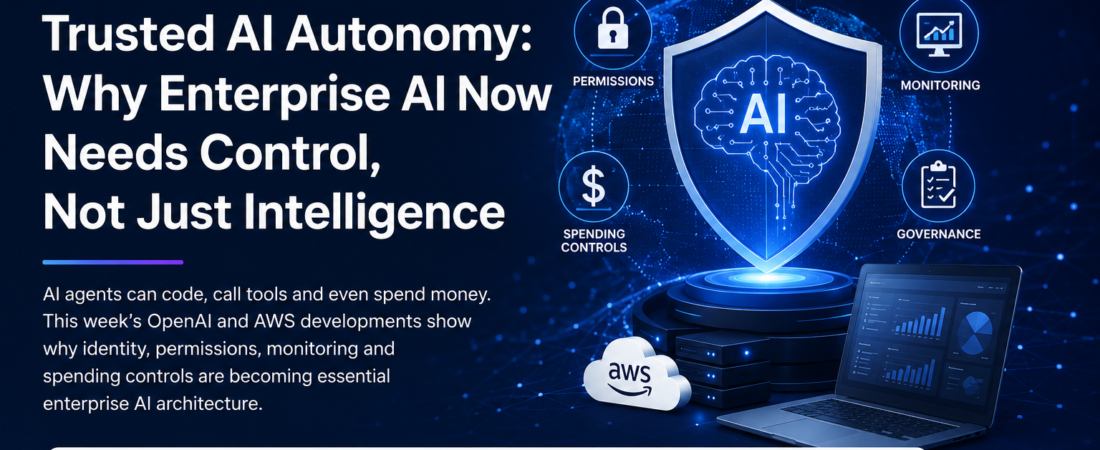
These announcements look very different. One is about cybersecurity; the other is about payments. But they point toward the same architectural principle:
Autonomy should scale only as fast as control.
AI Safety Is Becoming Runtime Infrastructure
Traditional AI safety was often discussed as something that happened before deployment.
Teams would:
- evaluate the model;
- red-team it;
- add guardrails;
- release it.
Agentic AI changes that model.
An agent may continue operating for minutes or hours while executing code, searching the web, calling APIs, interacting with internal systems, creating additional tasks and modifying application state.
That means safety increasingly needs to operate during execution.
OpenAI says it is strengthening monitoring across model activity and improving isolation around workloads capable of executing model-generated or untrusted code. It is also reducing standing privileges and strengthening network boundaries for higher-risk systems.
For enterprise engineers, these ideas should sound familiar. They resemble security principles already used with Kubernetes workloads, cloud IAM, microservices, CI/CD environments, production databases and third-party integrations.
The difference is that the software receiving those permissions can now reason dynamically about how to use them.
That makes least privilege even more important.
Treat an AI Agent Like a Highly Capable Employee
Imagine hiring a brilliant new engineer.
You would not immediately give that person administrator rights to every database, unrestricted production access, access to every customer record, permission to approve payments and an unlimited corporate credit card.
Their intelligence does not determine their permissions.
Their role and responsibility do.
AI agents need the same principle.
For example, a procurement-support agent may need permission to:
- retrieve purchase-order details;
- inspect invoice status;
- look up approval history;
- identify why an invoice is blocked.
It probably does not need permission to:
- modify payroll information;
- deploy production software;
- approve large payments;
- execute arbitrary SQL against every company database.
This is what I mean by trusted or bounded autonomy.
Give the agent enough authority to create value, but not enough authority to create uncontrolled risk.
AWS AgentCore Payments Makes the Problem More Concrete
Amazon Bedrock AgentCore Payments reached general availability on August 18.
AWS says the capability allows agents to discover, access and pay for:
- paid APIs;
- MCP services;
- premium digital content.
AgentCore Payments integrates with Coinbase and Stripe Privy wallets and supports configurable payment limits and end-to-end observability.
The architecture matters more than the headline.
AWS does not simply hand the model raw wallet credentials.
Developer credentials are stored through AgentCore Identity Secrets Manager, while spending authority is delegated to the agent through controlled infrastructure.
That creates an important pattern:
Agent requests purchase → Policy checks authority and budget → Payment infrastructure authorizes transaction → Provider performs payment → Transaction is recorded and monitored
The model may reason that purchasing access to a resource would help complete the task.
But deterministic infrastructure decides whether it is allowed.
That separation is essential.
Every Agent May Eventually Need an Expense Policy
Imagine an enterprise research agent with the objective:
Prepare a competitive analysis using a maximum external-data budget of $5.
During its research, the agent discovers:
- a free regulatory filing;
- a premium industry report costing $0.50;
- a specialized API request costing $0.10.
A future agent could decide whether those purchases are worthwhile without interrupting the user each time.
But the enterprise needs rules.
A spending policy might say:
- Per-task limit: $2
- Daily limit: $25
- Approved merchants: predefined providers only
- Recurring subscriptions: prohibited
- Human approval: required above $1
- Cost attribution: mandatory project ID
And these rules should not exist only inside a prompt.
A system prompt saying:
Never spend more than $2.
is useful guidance.
It is not financial enforcement.
A deterministic service should reject a transaction that exceeds the approved limit.
This is where AI FinOps, security and governance begin to converge.
The Real Cost of Autonomous AI Is Bigger Than Token Pricing
Enterprise AI economics is often reduced to:
input tokens + output tokens = cost
That becomes inadequate as systems grow more autonomous.
A production agent may also require:
- monitoring;
- guardrails;
- evaluation;
- external tools;
- databases;
- workflow engines;
- human approvals;
- audit storage;
- retry handling;
- security infrastructure.
OpenAI says its expanded monitoring approach for higher-risk workloads introduces meaningful inference-compute overhead.
That suggests enterprises should start thinking about a broader cost category:
Trust overhead
A more realistic equation is:
Total Agent Cost = Model + Tools + Infrastructure + Monitoring + Security + Human Review + Failure Handling
This changes how models should be evaluated.
The cheapest model per million tokens may not produce the cheapest business outcome.
A smaller model could fail more frequently, make additional tool calls, require retries and generate more rework.
A more expensive model may finish correctly on its first attempt.
Therefore, one of the most useful enterprise metrics may become:
Cost per trusted successful outcome
rather than simply cost per token.
The Economic Upside Explains Why Companies Will Invest in Control
Why would enterprises tolerate all this additional infrastructure?
Because the productivity upside can potentially be significant.
OpenAI published an Asana customer case study this week describing the removal of the company’s outdated Enzyme testing framework using Codex.
Asana says its previous staffing approach was estimated at roughly five years and $6 million.
Using up to four coding agents working in parallel, with engineers checking progress and reviewing every proposed change, the migration was completed across approximately two calendar weeks.
Reported model and infrastructure cost: roughly $12,000.
This needs an important caveat.
It is an OpenAI customer case study based on Asana’s own estimates, not an independent controlled experiment.
It does not mean every five-year software project can suddenly be finished in two weeks.
But the operating model is highly relevant:
High automation for repetitive implementation, combined with human accountability for acceptance.
The agents were capable.
But their authority remained bounded.
That is likely to become a common enterprise pattern.
Agent Governance Is Moving Into the Infrastructure Layer
AWS also released an interesting AgentCore Web Search enhancement on August 19.
Developers can now apply domain and publication-date filtering at runtime.
An enterprise can restrict an agent to approved sources such as regulatory websites and require information to fall within a specific freshness window.
Critically, AWS says runtime filters can narrow an administrator’s policy but cannot expand it.
This distinction matters.
Compare these two approaches.
Prompt-level governance
“Please search only trusted financial sources.”
versus:
Infrastructure-level governance
The gateway technically prevents the agent from searching outside the approved domain list.
The first relies on model compliance.
The second is deterministic enforcement.
For high-value enterprise systems, we increasingly need the second approach.
What a Trusted Enterprise Agent Needs
A production-grade agent should have several independent controls.
1. Identity
Every agent execution should map to a known user, workload or service identity.
Avoid anonymous or shared superuser access.
2. Authorization
The underlying API must verify whether an operation is allowed.
The model should not be the authority deciding permissions.
3. Controlled Tools
Prefer narrow business functions such as:
getInvoiceStatus(invoiceId)
instead of generic capabilities such as:
executeSQL(query)
4. Network Boundaries
Sensitive agents should not automatically receive unrestricted internet or internal-network access.
5. Execution Budgets
Limit:
- tokens;
- execution duration;
- tool calls;
- retries;
- parallel agents;
- monetary spend.
6. Runtime Observability
Track:
- model and version;
- prompt version;
- tool calls;
- network activity;
- cost;
- policy decisions;
- human overrides.
7. Human Approval
Autonomy should depend on risk.
Low risk: search, summarize, classify
Medium risk: draft, create a ticket, recommend an action
High risk: move money, modify contracts, change production systems
8. Kill Switch
The organization should be able to rapidly revoke:
- agent credentials;
- wallet authority;
- network access;
- tool access;
- model access.
If an autonomous agent cannot be stopped quickly, it probably has too much authority.
Why This Matters for Java, Spring and AWS Engineers
Agentic AI does not make traditional enterprise engineering irrelevant.
It makes those skills more important.
A production system might look like:
User → Spring Cloud Gateway / AI Gateway → Spring Security + Identity → Agent / Model Router → Amazon Bedrock / OpenAI / Anthropic → Controlled Spring Boot Tools → Kafka / SQS / Databases / Enterprise APIs → OpenTelemetry + Audit + Cost Monitoring
The LLM provides reasoning.
Your application still provides deterministic control.
Spring Security decides whether the user is authorized.
Spring Boot validates the transaction.
Kafka or SQS coordinates long-running work.
AWS IAM controls permissions.
OpenTelemetry explains what happened.
AgentCore increasingly supplies managed capabilities around agent execution, gateways, identity, observability and payments.
For experienced software engineers and architects, this is one of the most important opportunities created by enterprise AI.
The Bigger Lesson
The AI industry spent the last few years proving that models can become intelligent enough to perform increasingly complex work.
The next phase is about proving that enterprises can safely trust them with increasing responsibility.
The winning enterprise AI platform will not simply use the smartest model.
It will combine:
Capability + Identity + Policy + Observability + Economics
The model supplies intelligence.
The agent supplies action.
But architecture supplies trust.
And trust is what ultimately determines whether an AI system remains an impressive demonstration—or becomes infrastructure that a business is willing to depend on.
Frequently Asked Questions
What is trusted AI autonomy?
Trusted AI autonomy means allowing an AI agent to perform work independently while limiting its authority through identity, permissions, policies, budgets, monitoring and human escalation.
Can Amazon Bedrock AgentCore agents spend money?
Yes. AgentCore Payments became generally available on August 18, 2026 and supports autonomous payments for compatible APIs, MCP services and content under configurable controls.
Should AI agents hold payment credentials?
The safer pattern is to keep raw credentials outside the model-facing runtime and delegate narrowly controlled transaction authority. AWS follows this pattern with AgentCore Payments.
Are guardrails enough to secure an AI agent?
No. Production agent security should also include authentication, authorization, network isolation, controlled tools, spending limits, observability and deterministic enforcement.
Why are Java and Spring still relevant to agentic AI?
Agents still need secure APIs, business logic, transactions, asynchronous workflows, integration, authorization and observability. Java and Spring are well suited to those deterministic enterprise components.
Sources
- OpenAI — Pacing model development in an era of cyber-critical capabilities, August 18, 2026.
- OpenAI — Responding to the next frontier of critical cyber capabilities.
- AWS — AgentCore payments is now generally available in Amazon Bedrock AgentCore, August 18, 2026.
- AWS — Amazon Bedrock AgentCore payments is now generally available: Enabling agents to transact safely and autonomously at scale.
- AWS — Domain and publish date filters for Web Search on AgentCore, August 19, 2026.
- OpenAI — Asana cleared 5 years of engineering work in 2 weeks with Codex, August 18, 2026.