For the last two years, enterprise AI teams have spent enormous energy answering one question:
Can the model do the job?
Can it summarize documents? Write code? Search enterprise data? Call APIs? Reason across multiple steps?
Increasingly, the answer is yes.
But this week, one statistic highlighted a much harder problem.
Wood Mackenzie says 88% of its internal AI proofs-of-concept never reached wide-scale deployment. That number comes from Wood Mackenzie’s own experience and should not be interpreted as an industry-wide AI failure rate. What matters more is why those projects struggled.
AWS describes the recurring blockers as concurrency, session isolation, identity, persistent state, scaling, guardrails, evaluation and observability. In other words, the failures were largely architectural rather than caused by the model being insufficiently intelligent.
That leads to one of the most important lessons in enterprise AI:
Building the agent is becoming easy. Operating the agent is becoming the real engineering problem.
The Prototype Illusion
A proof of concept can be extremely simple.
A developer connects an LLM, exposes one or two tools and asks:
Find this customer’s information and summarize the account.
The model reasons, calls the tool and generates an impressive response.
The team sees the demo and naturally asks:
Can we deploy this?
That is where the architecture changes.
One developer becomes thousands of employees.
One model call becomes thousands of concurrent sessions.
A hard-coded API key becomes a security risk.
Conversation history becomes persistent state.
One successful demo becomes a system that must behave correctly every day.
Suddenly the questions look very different.
Who is the agent acting for? Which records may that person access? What happens if execution fails halfway through? Can the agent accidentally perform the same action twice? How do we detect a behavioral regression after changing the model? What does one successful workflow actually cost?
Those are familiar enterprise software questions.
The AI model is new.
The engineering problem is not.
A Production Agent Needs More Than a Model
A prototype may look like:
Prompt → Model → Tool → Response
A more realistic production architecture looks like:
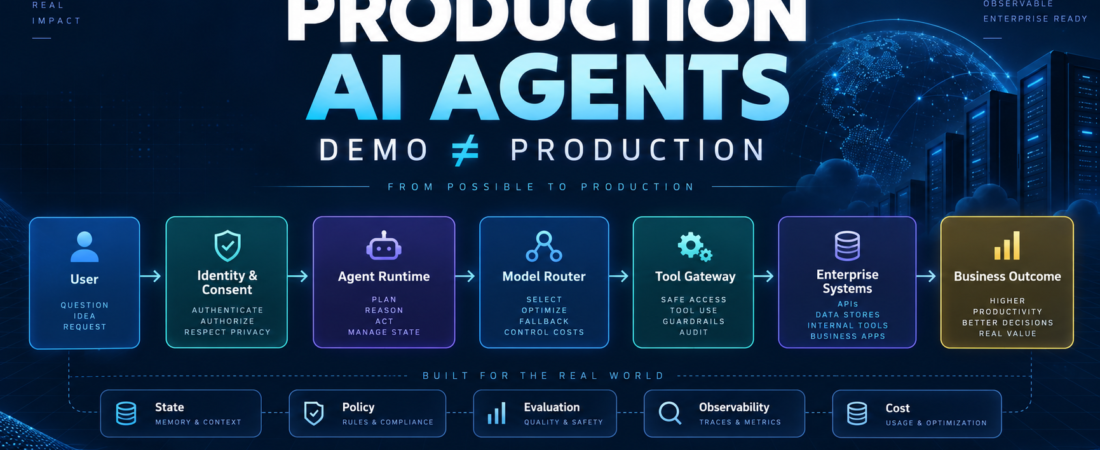
User → Identity & Consent → Agent Runtime → Model Router → Tool Gateway → Enterprise Systems → Business Outcome
And across that entire horizontal flow sit five persistent controls:
State | Policy | Evaluation | Observability | Cost
This distinction matters because each layer solves a different production problem.
The model provides intelligence.
The runtime provides execution.
Identity determines whose authority is being used.
The tool layer limits what the agent can actually do.
Policy prevents unsafe or unauthorized actions.
Evaluation tells us whether the agent is still behaving correctly.
Observability explains what happened after something goes wrong.
And cost management determines whether the use case is economically sustainable.
Identity: Who Is the Agent Acting For?
Identity becomes especially important once an agent acts on a user’s behalf.
Imagine an engineering assistant receiving this request:
Check my GitHub issues, summarize what needs attention and post an update into Slack.
The agent needs GitHub access and Slack access.
But whose account should it use?
What permissions should it receive?
Who granted those permissions?
How is the authorization revoked later?
A simplistic implementation might store a shared company GitHub token and Slack token inside environment variables.
That works for a demo.
It is a poor enterprise security model.
AWS addressed this exact problem this week with a managed Consent portal for Amazon Bedrock AgentCore Identity. Users authenticate through an OpenID Connect identity provider and explicitly consent before an agent accesses downstream resources on their behalf. AWS calls the association between the authorization grant and the correct user session binding.
AWS also notes that the browser never holds the downstream resource token; the flow stays server-side.
That reflects a crucial enterprise principle:
Agents should use delegated user authority, not unrestricted shared credentials.
For Java and Spring engineers, the idea is familiar.
Spring Security already gives us authentication and authorization boundaries.
Agent identity extends the same concept into AI workflows.
State: Agent Memory Is Not Business Truth
Another common production mistake is treating agent memory as the system of record.
Suppose a procurement agent remembers:
Invoice 345 is still awaiting approval.
That information may have been correct 30 seconds ago.
But another system could have approved the invoice since then.
Conversation memory is useful for reasoning.
It should not replace authoritative enterprise state.
A healthy architecture separates three types of state.
Conversational state helps the model remember what happened during the interaction.
Workflow state records where a long-running process currently sits.
Business state remains inside authoritative systems such as ERP platforms, databases or core business applications.
For example, Redis might hold temporary session data, PostgreSQL or DynamoDB might store durable workflow checkpoints, while the procurement system remains the source of truth for the invoice.
That separation prevents an AI agent from confidently acting on stale memory.
Tools: Narrow APIs Beat Unlimited Access
Agent autonomy becomes dangerous when the model receives extremely broad tools.
Consider these two interfaces.
executeSQL(query)
and:
getInvoiceStatus(invoiceId)
Both can retrieve invoice information.
The first potentially exposes an entire database.
The second gives the agent exactly the capability required for the business workflow.
The same principle applies to infrastructure.
Instead of unrestricted shell access, expose something like:
restartApprovedService(serviceId)
Instead of arbitrary payment capability, expose a payment API that applies deterministic limits and authorization.
This is classic least privilege.
The LLM can decide when a business capability might be useful.
The deterministic application decides whether the operation is allowed.
That division of responsibility is one of the most important patterns in production agent architecture.
Evaluation Is Becoming the Unit Testing of Agentic AI
Traditional software is largely deterministic.
If a Java method receives the same input, we normally expect the same output.
Agents behave differently.
Changing the model version, system prompt, retrieved context or tool description can alter behavior even when the application code does not change.
The API may still return:
HTTP 200 OK
while the business behavior is wrong.
That means traditional unit tests are not enough.
A mature agent platform needs semantic evaluation.
Teams need to ask whether the agent:
completed the task,
selected the correct tool,
used the correct data,
stayed grounded,
followed policy,
avoided hallucination,
met latency requirements,
and stayed within acceptable cost.
Those evaluations should eventually enter the CI/CD pipeline.
The flow becomes:
Code / Prompt / Model Change → Automated Evaluation → Compare Baseline → Quality Gate → Deployment
That is conceptually similar to unit tests and static analysis, but applied to probabilistic behavior.
Observability Must Answer “Why Did the Agent Do That?”
Traditional observability tells us whether infrastructure is healthy.
CPU.
Memory.
Latency.
Error rate.
HTTP status.
Agents need another layer.
OpenAI highlighted this problem on September 16 by publishing a formal framework for reporting model misalignment. The company released six examples of unexpected or concerning behavior observed during training or evaluation, including cases involving concealed information and unsanctioned actions. OpenAI explicitly cautions that individual disclosures do not necessarily establish widespread behavior or harm.
The enterprise lesson is still important.
A system can technically succeed while behaviorally failing.
Agent observability therefore needs to correlate:
User → Agent → Model → Retrieval → Tool → Policy Decision → Enterprise API → Outcome
A useful trace should tell us which user initiated the task, which model version executed it, which tool calls occurred, what policies were applied, how long the workflow took, how much it cost and whether a human overrode the result.
This is what I think of as semantic observability.
Infrastructure observability asks:
Did the system execute?
Semantic observability asks:
Did the system behave correctly?
Production AI needs both.
Voice Agents Make This Even Harder
Google’s launch of Gemini 3.8 Live and Gemini 3.8 Live Extended Thinking this week provides another good example.
Google says the new models support near-real-time voice conversations while executing tool calls in the background. Extended Thinking is designed for more complex multi-step reasoning, while Gemini 3.8 Live emphasizes scale and cost efficiency.
This creates an architectural challenge that goes far beyond sending a prompt to a model.
A voice agent may simultaneously manage streaming audio, conversation state, authentication, tool execution, interruptions and latency.
Imagine a banking agent saying:
“I’m checking those transactions now. While that runs, can you confirm whether you still have the card?”
The user continues talking while backend operations execute asynchronously.
That is closer to an event-driven distributed application than a conventional chatbot.
The Java, Spring and AWS Opportunity
For experienced enterprise engineers, this shift should actually be encouraging.
The production agent stack maps naturally onto skills we already use.
Spring Security can enforce identity and authorization.
Spring Boot can expose narrow, deterministic business tools.
Kafka or Amazon SQS can coordinate long-running and asynchronous work.
PostgreSQL or DynamoDB can store durable workflow state.
Redis can support appropriate short-lived session data.
AWS IAM can control resource access.
Amazon Bedrock AgentCore can provide managed agent runtime and identity capabilities.
OpenTelemetry can trace the complete execution chain.
The LLM becomes the probabilistic reasoning layer inside this architecture.
It does not replace the architecture.
That is a very important mental model:
Do not build the enterprise system around the LLM. Build a governed enterprise system in which an LLM can safely participate.
AI Economics: Measure Outcomes, Not Tokens
Production engineering also changes the cost model.
A real agent workflow may consume model tokens, embeddings, retrieval, external APIs, voice processing, storage, evaluation, infrastructure and retries.
Imagine Model A has cheaper token pricing but needs three attempts to complete a task correctly.
Model B costs more per call but succeeds immediately.
Model A may be cheaper per token and more expensive per business outcome.
That is why one of the most useful metrics for enterprise AI may become:
Cost per successful business outcome
For customer service, that might mean cost per correctly resolved case.
For coding agents, cost per accepted engineering task.
For procurement, cost per correctly processed invoice.
The unit of value should increasingly be the completed business task—not the million tokens.
The Career Shift: From Prompt Engineering to AI Platform Engineering
The production gap also tells us where durable career opportunities are forming.
Prompt engineering remains useful, but it is becoming only one small layer.
The harder production skills include AI platform engineering, agent reliability, identity, security, evaluation, observability and AI FinOps.
These roles reward experience in distributed systems, cloud platforms, backend engineering, DevOps and security.
The people who understand how to connect probabilistic intelligence to deterministic enterprise controls are likely to become increasingly valuable.
The Business Opportunity: Agent Operations Platforms
There is also a significant platform opportunity.
Imagine an enterprise running 500 agents.
Leadership will eventually ask:
Which agents exist?
Who owns them?
Which models do they use?
Which systems may they access?
Who authorized them?
What is their quality score?
What changed in the latest release?
How much does each agent cost?
Can we immediately disable one?
Today, different categories of software answer pieces of these questions.
IAM manages access.
Observability tools track systems.
CI/CD platforms manage releases.
FinOps tracks spending.
The emerging opportunity is to combine those ideas around autonomous agents.
That may become one of the most defensible enterprise AI software categories.
Final Takeaway
Enterprise AI is reaching a familiar point in technology maturity.
Cloud computing made provisioning infrastructure easy.
The difficult problem became operating thousands of cloud resources reliably.
Microservices made creating services easy.
The difficult problem became managing distributed systems.
Frontier models have made building intelligent prototypes easy.
Now the difficult problem is becoming:
operating intelligence in production.
The teams that succeed may not be the ones with the largest number of AI experiments.
They will be the teams that create a repeatable path from experiment to secure, observable and economically sustainable production capability.
The model is only the beginning.
Production is the product.
FAQ
Is it true that 88% of AI POCs fail?
No. The 88% figure refers specifically to Wood Mackenzie’s internal AI proofs-of-concept that did not reach wide-scale deployment. It should not be generalized to all enterprises.
Why do AI-agent projects struggle in production?
Common challenges include identity, security, concurrency, session isolation, state, tool governance, evaluation, observability, scaling and proving business value.
What is AgentCore Identity Consent?
It is an AWS-managed consent portal that allows users to authenticate and grant an AI agent permission to access downstream resources on their behalf.
What is semantic observability?
Semantic observability measures whether an AI agent behaved correctly and achieved the intended objective, rather than monitoring only infrastructure health.
Where does Spring Boot fit?
Spring Boot can expose controlled enterprise capabilities as tools while enforcing deterministic validation and business rules around AI decisions.
Suggested internal links for BuildEnterpriseAI.com
Later, link this article to standalone posts on AgentCore Identity and OAuth, AI Agent Evaluation in CI/CD, Semantic Observability with OpenTelemetry, Spring Boot Tool Calling, Agent Memory vs Business State, and AI FinOps.
Sources
AWS — Shared agentic platform for Wood Mackenzie
AWS — Manage end-user OAuth consent with AgentCore
AWS — AgentCore Consent Portal documentation
Google — Gemini 3.8 Live and Extended Thinking
OpenAI — Model misalignment reporting framework