AI Economics Moves Down the Stack: OpenAI Jalapeño, NVIDIA’s $96B Quarter & AWS’s Production AI Push
For much of the generative AI boom, the industry’s attention has been focused on one question:
Which company has the most capable model?
This week suggests that another question is becoming just as important:
Who can run increasingly capable AI systems faster, cheaper, and reliably at massive scale?
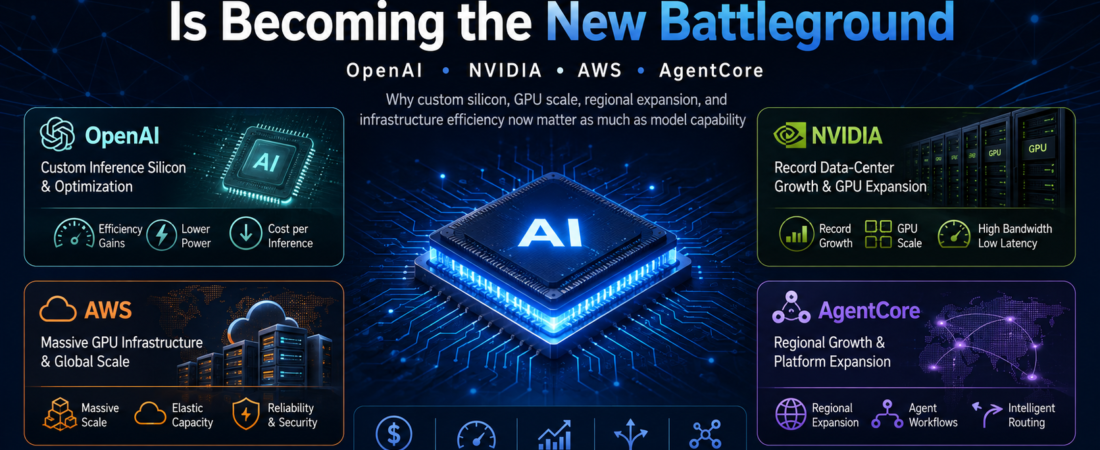
Between OpenAI publishing the first measured results from its custom Jalapeño inference chip, NVIDIA reporting a $96.2 billion quarter, AWS and NVIDIA planning another 2 million GPUs, and AWS expanding its production-agent infrastructure, the signal is becoming difficult to ignore.
The next phase of enterprise AI competition is increasingly about the entire AI stack — chips, networking, inference economics, cloud capacity, agent runtime, security, observability, and production operations.
1. OpenAI Publishes First Results From Its Jalapeño Inference Chip
OpenAI published the first measured performance results for Jalapeño, its first custom inference chip, on August 25.
According to OpenAI, the chip is designed to improve two things that frequently compete with each other in inference systems:
throughput and latency.
OpenAI says Jalapeño can process more AI workloads per unit of power while also returning responses faster than the commercial systems used in its comparison. The company tested the architecture across multiple model families, including GPT-OSS 120B, DeepSeek R1 and Kimi K2.5.
This matters beyond hardware benchmarking.
AI applications increasingly involve long-running reasoning, coding sessions and autonomous agents that can generate enormous numbers of tokens. At enterprise scale, even relatively small reductions in inference cost or latency can materially change the economics of a system.
A faster token stream can mean:
User → Agent → Model → Tools → Model → Response
finishes faster.
Better throughput per kilowatt can mean the same data center serves more AI requests.
That turns inference optimization from an infrastructure detail into a product and business advantage.
Enterprise takeaway
The future AI stack is unlikely to be optimized at only one layer.
OpenAI is increasingly describing an integrated architecture spanning chips, data centers, models, developer platforms and products. Better hardware improves model economics, while software and models can also influence how the hardware itself is designed.
For enterprise architects, the lesson is important:
Model selection alone will not determine the cost or responsiveness of production AI. Inference architecture will.
2. NVIDIA’s $96.2 Billion Quarter Shows How Large AI Infrastructure Demand Has Become
One day later, NVIDIA provided perhaps an even stronger economic signal.
For its fiscal Q2 2027, NVIDIA reported:
| Metric | Q2 FY2027 |
|---|---|
| Total revenue | $96.2B |
| YoY revenue growth | 106% |
| Data Center revenue | $89.0B |
| Data Center YoY growth | 117% |
Those numbers show that AI infrastructure demand is not slowing as enterprises move from experimentation toward production.
NVIDIA CEO Jensen Huang summarized the shift by arguing that AI is increasingly performing useful economic work and that compute itself is becoming directly connected to revenue generation.
That is particularly important for agentic AI.
A traditional application may make a predictable number of backend requests.
An agent might instead:
Reason → call a tool → inspect the result → reason again → search → call another service → validate → generate output.
The amount of compute consumed by a single user task can therefore be significantly larger and less predictable.
As enterprise agents become more capable, infrastructure efficiency becomes increasingly important.
3. AWS and NVIDIA Plan Another 2 Million GPUs
The scale of future infrastructure investment became even clearer on August 26.
AWS and NVIDIA announced plans to deploy 2 million additional NVIDIA GPUs across AWS infrastructure during 2027–2028. The expansion is intended to support workloads including agentic AI, enterprise automation, scientific computing and physical AI.
The partnership goes well beyond simply adding GPU capacity.
AWS and NVIDIA also announced deeper work around NVIDIA Vera CPUs, advanced networking, NVLink technology, Nemotron open models, accelerated data processing and vector indexing, and robotics infrastructure.
The architectural message is significant.
An enterprise AI platform increasingly looks less like:
Application → LLM API
and more like:
Applications → Agents → Models → Accelerators → High-speed networking → Data infrastructure → Tools → Observability
Every layer affects performance and cost.
Why enterprises should care
Organizations may not directly purchase millions of GPUs.
But they consume this infrastructure indirectly through services such as AWS, Bedrock and other managed AI platforms.
Massive cloud infrastructure investment can ultimately translate into:
- more inference capacity
- larger model availability
- faster agent workloads
- broader hardware choices
- lower cost per unit of useful AI work
The competitive battlefield is therefore shifting toward AI infrastructure supply and efficiency.
4. AWS AgentCore Continues Moving Agents Toward Production Infrastructure
The other important development this week came from Amazon Bedrock AgentCore.
AWS expanded AgentCore into US West (N. California) and Asia Pacific (Hyderabad) on August 27.
The platform now exposes production-oriented capabilities in those regions including runtime infrastructure, identity and access control, policy management, session persistence, tool connectivity, evaluation and observability.
This matters because building an AI agent is comparatively easy.
Running one reliably in production is much harder.
A production architecture may need to answer questions such as:
Who is the agent?
Which tools can it access?
What actions is it allowed to perform?
How long should its session persist?
How do we evaluate its behavior?
How do we observe failures and unexpected tool usage?
These are infrastructure and governance problems rather than purely model problems.
AWS’s direction with AgentCore reinforces a broader shift across enterprise AI:
Agent development is evolving from prompt engineering into distributed systems engineering.
5. Hyderabad Also Gets New Blackwell Ultra GPU Capacity
There was another relevant AWS infrastructure update on August 28.
AWS made EC2 P6-B300 instances available in additional regions including Asia Pacific (Hyderabad).
These instances use eight NVIDIA Blackwell Ultra GPUs and are designed for large-scale AI training and inference workloads, including very large foundation models. AWS says the generation offers higher GPU memory, networking bandwidth and AI compute than the previous P6-B200 generation.
Combined with AgentCore’s Hyderabad availability, this is another indication that advanced AI infrastructure is becoming increasingly regionally distributed rather than concentrated in only a handful of US regions.
For enterprises, regional availability matters for latency, data-residency architecture and regulated workloads.
The Bigger Story: AI Economics Is Moving Down the Stack
These announcements may initially look unrelated:
OpenAI → custom inference silicon
NVIDIA → record data-center revenue
AWS + NVIDIA → millions of additional GPUs
AWS AgentCore → production agent infrastructure
But together they tell one story.
The AI industry is optimizing the entire path from silicon to application.
A simplified enterprise stack is beginning to look like:
AI Application
↓
Agent Runtime & Orchestration
↓
Identity / Policy / Guardrails
↓
Model
↓
Inference Runtime
↓
GPU / Custom Accelerator
↓
Networking & Data Center
Optimizing any single layer helps.
Optimizing all of them together can fundamentally change the economics of running AI.
What This Means for Enterprise AI Teams
For enterprise architects and engineering leaders, I would take four practical lessons from this week.
First, measure inference economics — not just model quality. Two models capable of solving the same problem can have very different latency, token consumption and infrastructure costs.
Second, design agents as production systems. Identity, permissions, observability, evaluation, rate limits and failure handling should be part of the architecture from the beginning.
Third, keep infrastructure flexibility. GPU availability, custom silicon and cloud accelerators will continue changing quickly. Avoid unnecessarily coupling the entire application architecture to one hardware assumption.
Fourth, optimize the whole request path. RAG quality, caching, context size, model routing, prompt design and tool usage can sometimes reduce infrastructure costs before adding more compute.
Why This Week Matters
Model capability will obviously continue improving.
But the next generation of enterprise AI will not be won solely by organizations with access to the smartest model.
It will also depend on who can deliver intelligence:
faster, cheaper, securely, reliably and at enormous scale.
OpenAI is moving deeper into custom inference hardware. NVIDIA’s financial results show extraordinary demand for AI compute. AWS and NVIDIA are preparing millions more GPUs, while AWS is simultaneously building the runtime and governance layer needed to operate AI agents in production.
The industry is gradually connecting all of these pieces.
And that may be the most important AI architecture story of the week.
Sources
For the WordPress article, I recommend making these text links at the bottom rather than adding a very long references section:
OpenAI — Jalapeño’s first inference results
OpenAI — The full stack behind abundant intelligence
NVIDIA — Q2 FY2027 financial results
NVIDIA — AWS partnership and 2 million additional GPUs
AWS — AgentCore expands to Hyderabad and N. California
AWS — EC2 P6-B300 expansion